 GHADIMI FINANCE
What is the Silver Bullet?
The Silver Bullet is a model taught by Michael Huddleston (ICT). In specific hours of the day, price tends to take the liquidity on one side first and then move hard (displacement) toward the liquidity on the other side. That displacement leaves a fair value gap (FVG), and the entry is taken in that gap.
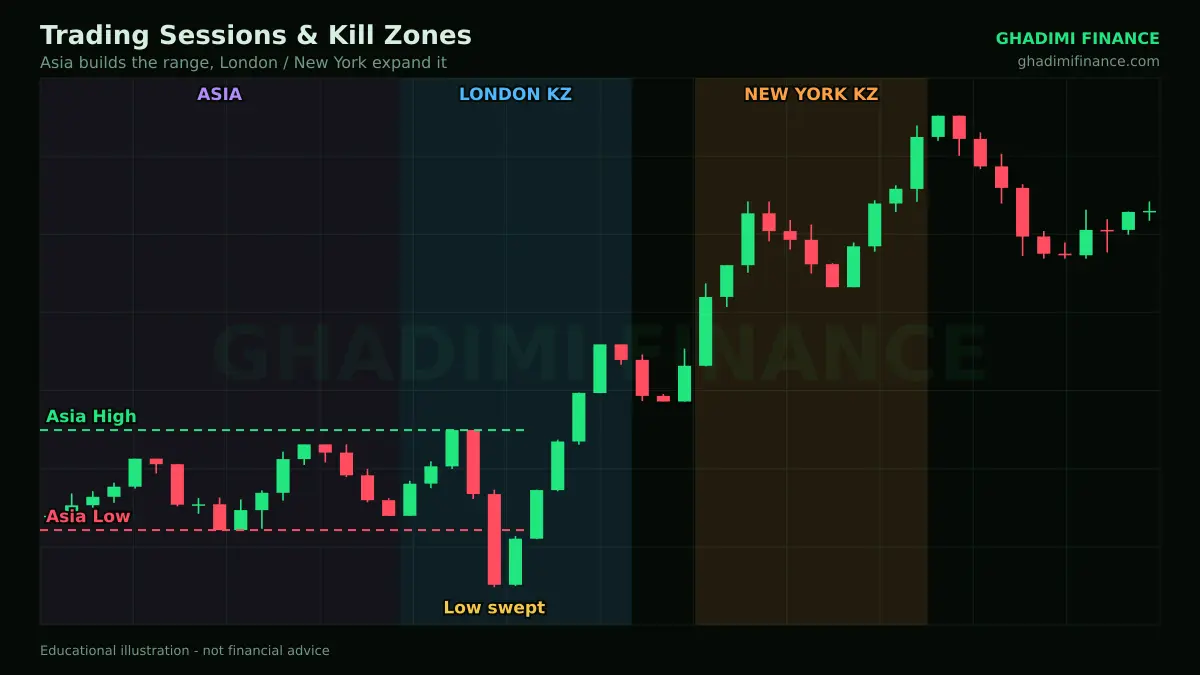
The three time windows (New York time)
| Window | New York | UTC (winter) |
|---|---|---|
| London | 3:00–4:00 AM | 08:00–09:00 |
| New York AM (the main one) | 10:00–11:00 AM | 15:00–16:00 |
| New York PM | 2:00–3:00 PM | 19:00–20:00 |
When the US is on daylight saving time the UTC hours move one hour earlier. The market sessions clock shows the windows in your own time and in your broker's server time, so you never have to convert by hand.
Step-by-step rules
- Take the bias from a higher timeframe. On H1 or M15, decide which liquidity price is drawn to (previous day's high or low, equal highs or lows…).
- Wait for the window. Nothing happens before the hour starts.
- The sweep. Inside the window, price usually runs a nearby high or low (BSL or SSL).
- Displacement and an FVG. After the sweep, a sharp move the other way leaves an FVG on M1 to M5.
- Entry. When price returns into the FVG, enter with a limit order or a lower-timeframe confirmation.
Stop, target and position size
The stop goes beyond the swing that created the FVG (or beyond the sweep). The target is the next pool of liquidity in the trade's direction; if it is not at least twice the risk away, skip the trade. Size the position from the risk, never from a feeling: the lot size calculator does it in seconds. On NASDAQ, moves smaller than 10–15 points are rarely worth the risk.
Common mistakes
- Taking any FVG in the window, even without a sweep.
- Trading straight into high-impact news (CPI, NFP, FOMC).
- Taking several trades in one window after the first loss (revenge trading).
- Ignoring the higher-timeframe direction.
My view: time is a filter, not a reason to enter
The window only tells you where to pay attention, not to enter. Inside these hours I still wait for a real reaction from price; I confirm it with a G Candle. — Mojtaba Ghadimi