 GHADIMI FINANCE
Definition and formula
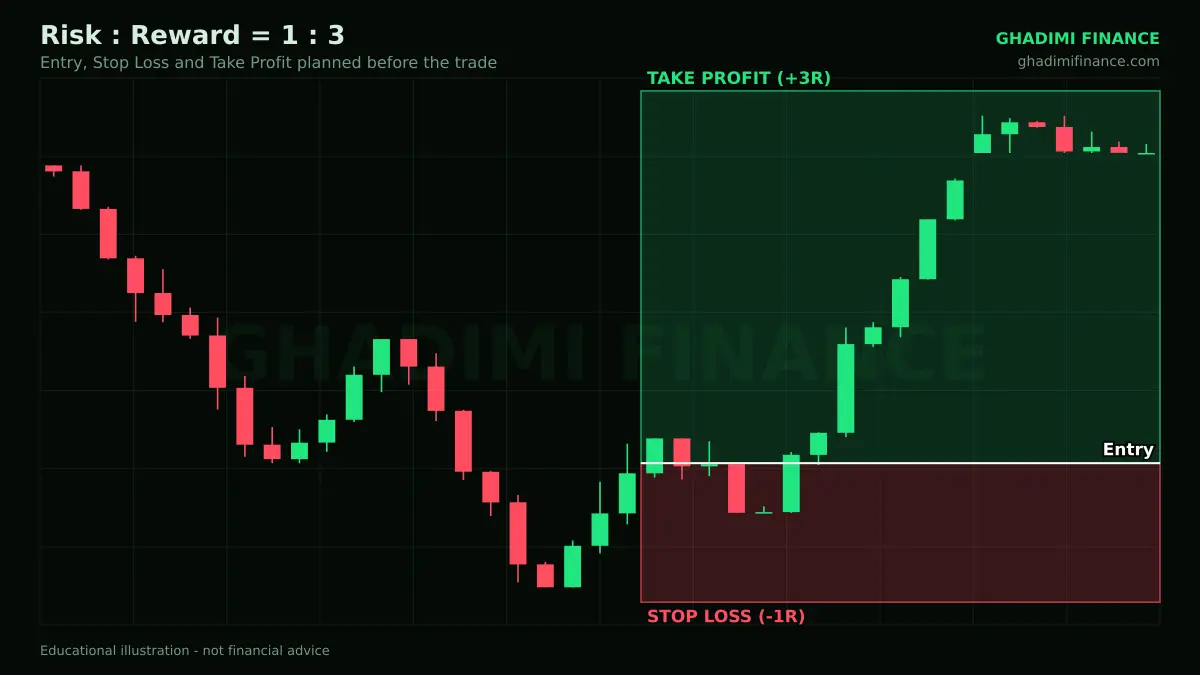
If your stop loss is 20 pips and your take profit is 40 pips, the ratio is 1:2: every time you win, you make twice what you could have lost. The amount you risk on a trade is also called "1R".
Minimum win rate for each ratio
The break-even win rate comes from this formula: 1 ÷ (1 + R)
| R:R ratio | Break-even win rate |
|---|---|
| 1:1 | 50% |
| 1:1.5 | 40% |
| 1:2 | 33.3% |
| 1:3 | 25% |
| 1:4 | 20% |
To actually make money you need to be a few points above these numbers, because spreads and commissions also count.
Expectancy: the number that really matters
0.45 × 20 − 0.55 × 10 = +3.5 $ → on average each trade makes $3.50 (0.35R).
Profit Factor is gross profit divided by gross loss; above 1.5 usually indicates a healthy system.
Is a higher R:R always better?
No. The further the target, the less likely price is to reach it. A setup with 1:4 R:R and a 15% win rate is worse than one with 1:2 and 45%. Choose the ratio from market structure (liquidity, highs and lows) and measure the result in your journal.
Three traders over 100 trades
| Trader | Win rate | R:R | Result over 100 trades |
|---|---|---|---|
| A | 60% | 1:1 | +20R |
| B | 40% | 1:2 | +20R |
| C | 25% | 1:4 | +25R |
All three are profitable, but they feel very different: trader C has to sit through long losing streaks — at a 25% win rate, 10 losses in a row are entirely normal. Pick an R:R style you can execute psychologically.
How to set R:R on the chart
- Stop loss: where the setup is invalidated (for example beyond the swing or the order block).
- Take profit: where price is logically drawn to — equal highs/lows liquidity, the previous day's high or low, or an opposing imbalance (FVG).
- If the distance to a logical target is less than 1.5 times the stop, it's usually better to skip the trade.
Losing streaks at every win rate
Losing streaks are far more likely than they feel. Over 100 trades at a 40% win rate, seeing 7–8 losses in a row is normal. That's why risk per trade has to be small enough that such a streak doesn't knock you out. See the money management rules.
Partial profits and break-even
Closing part of the position at 1R and moving the stop to entry raises your win rate and slightly lowers your average win. Details in the trailing stop and break-even article. After every trade, UMBRA calculates your real R, win rate, Profit Factor and expectancy.