 GHADIMI FINANCE
The three main sessions
Times in UTC. London and New York observe daylight saving time, so their UTC times shift by an hour between seasons; Tokyo does not.
| Session | Northern summer (UTC) | Northern winter (UTC) |
|---|---|---|
| Tokyo (09:00–18:00 Japan time) | 00:00 – 09:00 | 00:00 – 09:00 |
| London (08:00–17:00 London time) | 07:00 – 16:00 | 08:00 – 17:00 |
| New York (08:00–17:00 New York time) | 12:00 – 21:00 | 13:00 – 22:00 |
Exact opening and closing times differ slightly between sources. The US and Europe also change clocks on different dates, so for a few weeks in spring and autumn the gaps shift by an hour.
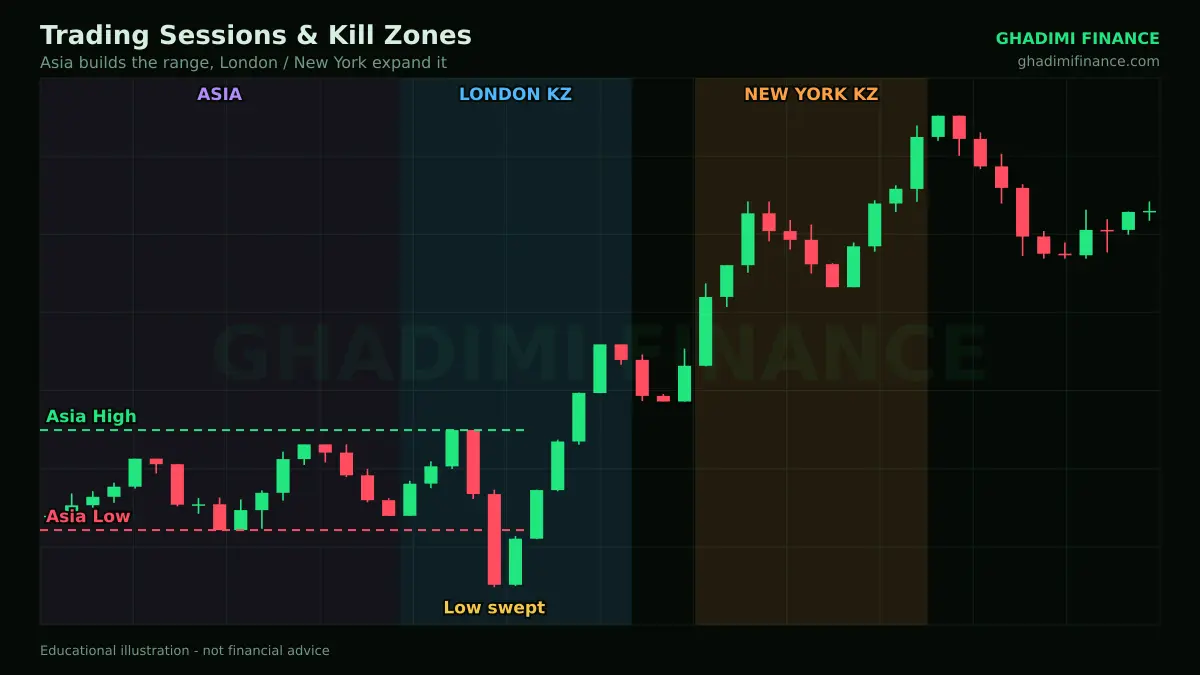
The London–New York overlap
From the New York open to the London close, the two biggest centres trade at the same time. For the major USD pairs, gold and US indices this is usually the most liquid part of the day: tighter spreads and bigger moves.
Winter: about 13:00 – 17:00 UTC
Major US economic data usually comes out at 08:30 New York time (12:30 UTC in summer, 13:30 UTC in winter). Trading those moments has its own rules (trading the news).
Which hours for which symbol?
- EURUSD, GBPUSD, gold: the London session and its overlap with New York.
- USDJPY, AUDUSD, NZDUSD: the Asian session matters too, besides London and New York.
- US indices (Nasdaq, Dow): the biggest moves come after the US stock market opens (09:30 New York; 13:30 UTC in summer, 14:30 UTC in winter).
The best hours for you are the ones where your setup has worked in backtests and your journal, and when you are actually alert and available.
Expensive hours
- Rollover (around 17:00 New York): 21:00 UTC in summer, 22:00 UTC in winter. Liquidity is thin and spreads can widen several times over; tight stops may be hit by the spread alone.
- Late Friday: thin liquidity and Monday gap risk.
- US or UK bank holidays: low volume and erratic moves.
Plan your trading window
Set a fixed window for trading and don't enter outside it. A fixed window makes your results comparable and stops tired, impulsive trades. In a prop challenge, also know when the server's trading day ends (for the daily loss limit).