 GHADIMI FINANCE
What a breaker block is
A breaker is an order block that failed and flipped its role.
Bearish breaker:
- Price makes a low and a bullish order block forms (the last down candle before the rally).
- Price rallies and sweeps the previous high (takes buy-side liquidity).
- It then drops hard and breaks the low that created the order block (bearish MSS).
- That failed bullish order block is now a bearish breaker and acts as resistance when price returns.
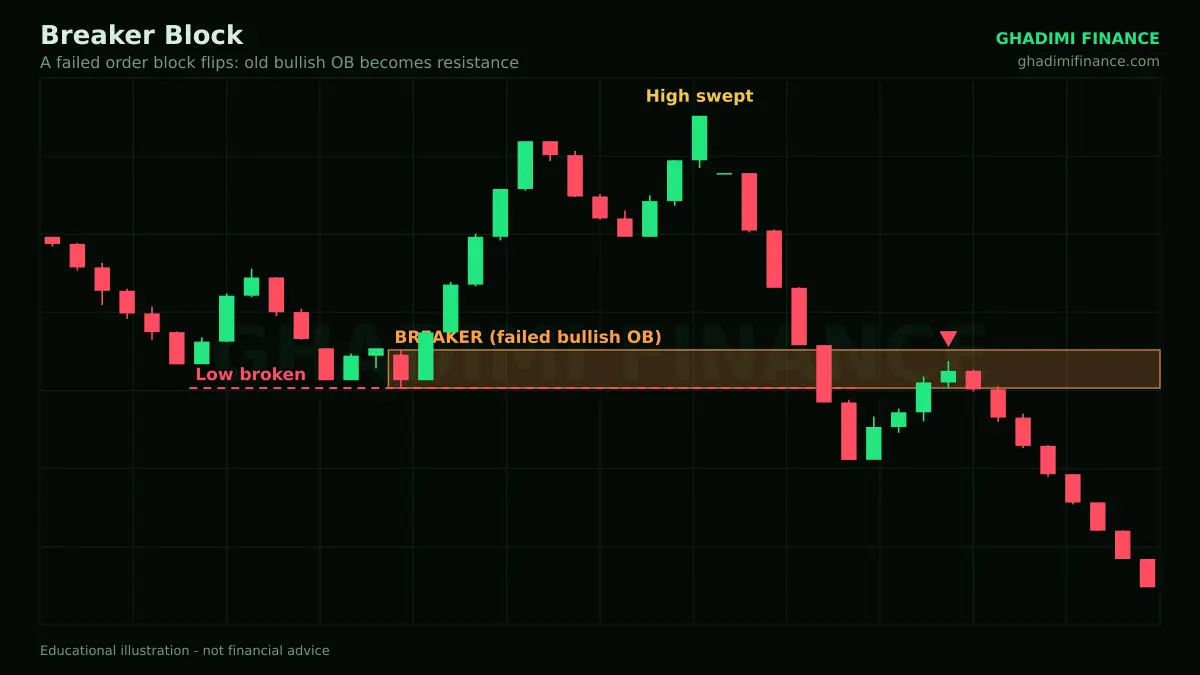
The bullish breaker is the mirror image: sweep of a prior low, break of a high, and the failed bearish order block turns into support.
Why breakers are strong
A breaker packs three ICT ideas into one zone: a liquidity sweep (the other side is trapped), a structure shift (direction changed) and a clear place for entry and stop. Traders who bought the old order block are losing; when price returns to their entry many sell to get out. It's the same logic as the support/resistance flip, with a liquidity layer added.
Breaker vs mitigation block
| Breaker block | Mitigation block |
|---|---|
| The prior high/low was swept before the break | The prior high/low was not swept (a lower high / higher low formed) |
| Usually stronger | Usually weaker |
How to trade it
- Set the higher-timeframe bias.
- See the full sequence: order block, liquidity sweep, structure break with displacement.
- Mark the breaker (the full candle or the body of the original order block).
- Wait for price to return; an overlapping FVG is a bonus.
- Stop beyond the breaker (or beyond the swept high for a safer stop).
- Target the opposite liquidity, such as the next lows.