 GHADIMI FINANCE
The core idea: price seeks liquidity
Institutions can't enter with one click like a retail trader. To fill large orders they need the other side, and that sits in retail stops and pending orders: above highs and below lows. So in ICT price does two main things:
- takes liquidity (liquidity sweeps);
- rebalances inefficiencies (FVGs).
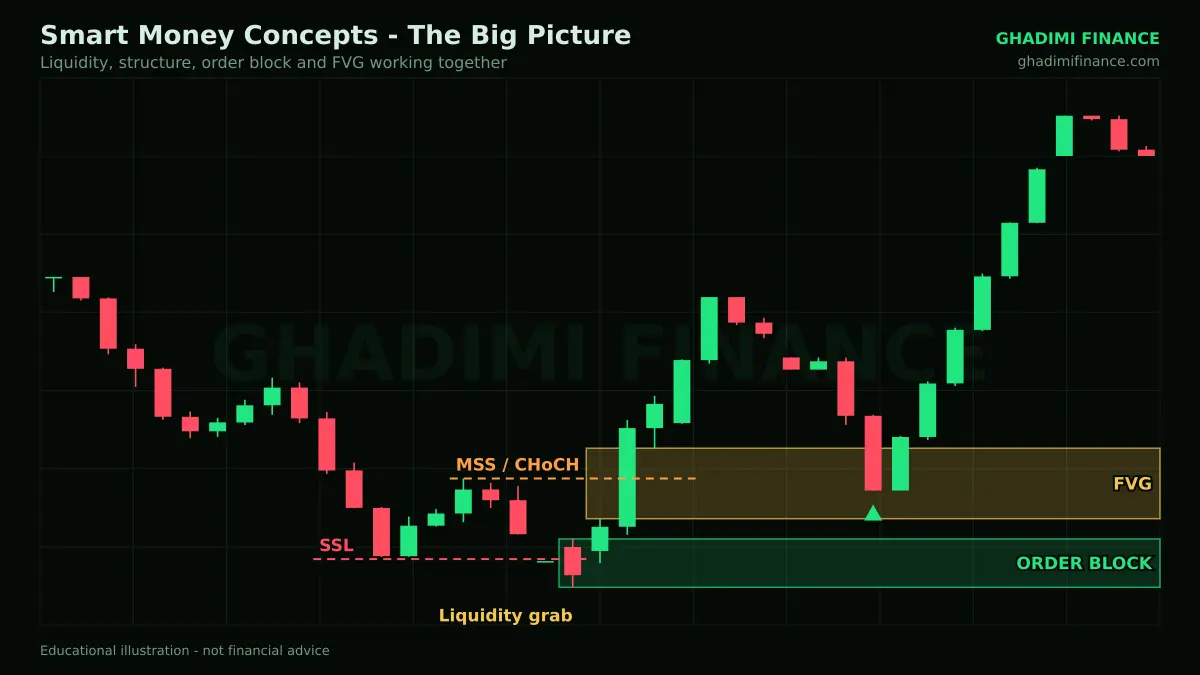
The map of concepts
- Market structure, BOS and CHoCH: read the lesson
- Liquidity, BSL and SSL: read the lesson
- Order blocks: read the lesson
- Fair value gaps and IFVG: read the lesson
- Premium, discount and OTE: read the lesson
- Breaker blocks: read the lesson
- Time: kill zones and Power of Three: read the lesson
- Putting it together: the ICT entry model
Classic price action vs ICT
| Classic price action | ICT / smart money |
|---|---|
| Support and resistance | Order blocks, FVGs, breakers |
| False breakout | Liquidity sweep |
| Double top = strong level | Equal highs = target (liquidity) |
| Trend break | CHoCH / MSS |
| Focus on shapes | Focus on the cause of the move + time |
ICT doesn't replace price action; it is a more precise version of it, so learn classic price action first.
Common mistakes
- Jumping to complex models without understanding structure and liquidity.
- Seeing order blocks and FVGs everywhere; only zones that broke structure or took liquidity count.
- Ignoring the higher-timeframe bias.
- Ignoring time: ICT setups work best in kill zones.